

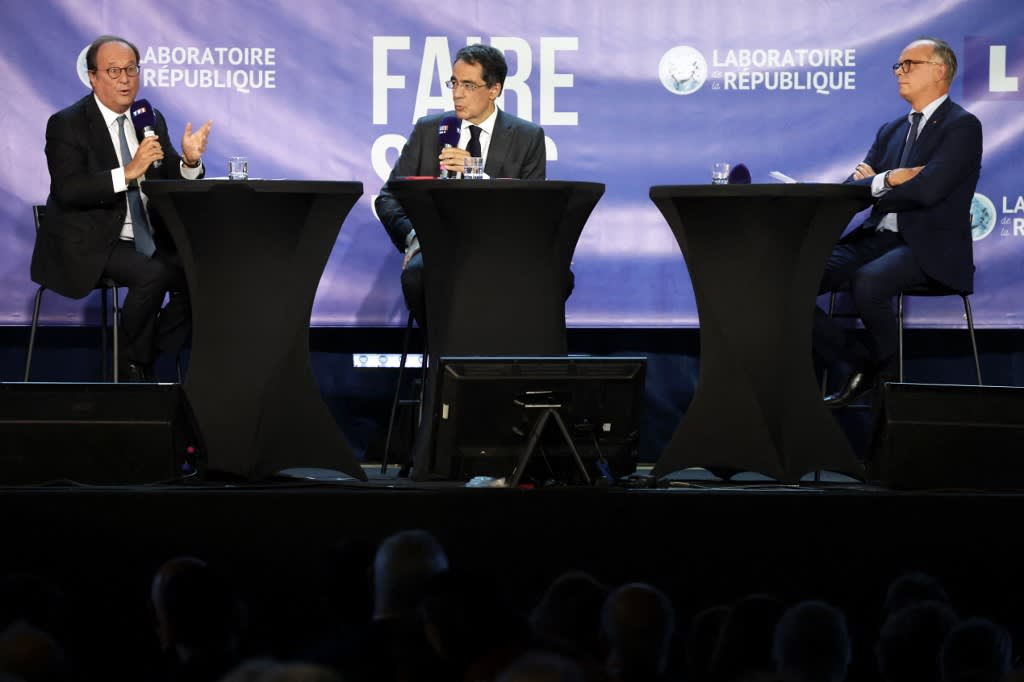
- Former President François Hollande and ex-Prime Minister Édouard Philippe debated for an hour and a half at the summer school of Jean-Michel Blanquer’s think tank.
- Faced with soaring public debt, Édouard Philippe advocates for a reduction in social spending, while François Hollande proposes a tax contribution from the wealthiest 0.1%.
- On immigration, the former Prime Minister defends the creation of detention centres outside the European Union, an option rejected by the former Head of State.
- With less than eight months until the 2027 presidential vote, both men expressed their shared rejection of the National Rally and La France Insoumise.
A civil dialogue ahead of the elections
This Saturday, 29 August 2026, in Sens, Yonne, former President of the Republic François Hollande and former Prime Minister Édouard Philippe met for a ninety-minute debate. Invited by the Laboratoire de la République, a think tank chaired by Jean-Michel Blanquer, the two men locked horns in a courteous manner with less than eight months to go before the 2027 presidential election. Faced with the polarisation of the current political landscape, both speakers expressed their commitment to republican principles and their categorical refusal to support political forces they consider extreme. François Hollande lamented the disappearance of traditional two-party politics while accusing La France Insoumise and the National Rally of hiding a desire to leave the European Union. This stance was shared by Édouard Philippe, who formally ruled out any vote in favour of these two parties.
Two economic visions to tackle public debt
The trajectory of French public finances was a major point of discussion between the two former executive leaders. Édouard Philippe warned of the risk of a brutal financial shock, drawing a parallel with the historic debt crisis in Greece. According to the Mayor of Le Havre, the sustainability of the system relies on controlling social spending, which he proposes to contain by taking inspiration from pension age reforms or the austerity policies applied in Italy. Conversely, while François Hollande shares the assessment of the gravity of the budgetary situation, his resolution strategy differs significantly. While the former Prime Minister refuses any increase in levies, the former Head of State advocates a fiscal effort targeted at the wealthiest taxpayers. François Hollande also reiterated his proposal for a partial de-indexing of pensions from inflation to address the budgetary drift.
Frontal disagreements on migration policy
Moderated by journalist Darius Rochebin, the debate became more animated during the examination of migration issues. The two political figures presented opposing solutions regarding the management of flows at both European and national levels. Édouard Philippe spoke in favour of selective immigration, reiterating his support for the principle of detention centres established outside the borders of the European Union, similar to initiatives led by the United Kingdom or Italy. He also defended his recent proposal to redirect migrants from Mayotte to Rwanda. This approach was firmly rejected by François Hollande, who described these outsourcing schemes as unrealistic and sometimes humiliating. The former President nevertheless conceded the need for Europe to show greater rigour in its reception procedures and border controls.